Grappling turns your workout into a focused practice that quiets your mind while your body does real work.
If your stress feels like it follows you everywhere, the usual advice to “just relax” can sound a little useless. What tends to work better is a clear task that pulls your attention into the present. That is one reason many people in Vacaville are choosing grappling as a practical way to reset after long days, heavy responsibilities, or just the general noise of modern life.
We see it every week: you walk in carrying mental clutter, you train with structure and purpose, and you leave feeling lighter and more organized inside your own head. This is not about pretending stress does not exist. It is about giving your nervous system a different job for an hour, then letting the calm stick around afterward.
Why grappling can feel like mindfulness without trying to be
Mindfulness is often described as paying attention to what is happening right now, without spiraling into everything else. Grappling naturally demands that. When you are learning how to move, balance, breathe, and respond to a partner, you cannot multitask mentally. Your focus gets narrowed to grips, posture, pressure, timing, and safety. That full engagement is the point.
There is also a physiological side that matters. Training hard, then recovering in a controlled environment, can help regulate stress hormones and shift your body toward a calmer state. Many students describe it as a “volume knob” turning down, especially after consistent training.
Research lines up with what we notice on the mat. In studies of Brazilian Jiu-Jitsu and related grappling styles, 87.5 percent of practitioners reported reduced anxiety, and 96.9 percent reported improved mood. Those are big numbers, but the more important detail is the pattern: when practice is consistent, the benefits tend to be consistent too.
Stress relief is not just “working out hard”
A run, a lift, and a conditioning circuit can be great. But grappling adds something that standard workouts often miss: feedback. A partner’s movement tells you immediately whether your technique and breathing are working. That makes training feel like a puzzle you solve in real time, and that puzzle pulls you away from rumination.
We structure class so you are not thrown into chaos. You learn a skill, you practice it with a cooperative partner, and only then do you add resistance gradually. That progression is what helps training stay therapeutic rather than overwhelming. It is also how you build confidence without needing to “tough it out” every session.
Over time, your brain starts to associate the mat with problem-solving and regulation. You feel stress, you breathe, you make decisions, you stay present. That carries over when you are stuck in traffic on I-80 or dealing with a tough meeting at work.
The mental health data that makes us take this seriously
We do not frame training as a replacement for professional mental health care, but we also do not treat stress relief as a vague side benefit. There is meaningful evidence behind it, including studies showing clinically significant changes for anxiety, depression, and trauma symptoms with consistent practice.
Here are a few findings that are worth knowing if you are considering adult training for mental health support:
• 87.5 percent of grappling practitioners reported reduced anxiety in survey-based research on BJJ participation.
• 87.6 percent of adults reported improved confidence from training.
• 81.3 percent reported enhanced mental flexibility, which matters when life throws curveballs and you need to adapt.
• In a structured multi-month program, effect sizes for PTSD, depression, and anxiety reduction ranged from 0.80 to 1.85, which is a strong signal that the change was not minor.
What we take from this is simple: consistent training can create measurable changes, especially when the environment is safe, structured, and community-based.
What “mindfulness through movement” looks like in class
You do not need to sit in silence for an hour to practice mindfulness. In fact, many people prefer an active approach because it feels more natural. Grappling creates mindfulness through clear constraints: position, pressure, timing, and the constant need to breathe well.
A typical class experience usually includes a few moments that stand out:
• You notice your jaw unclenching because you have to breathe to keep moving.
• You realize you were thinking about work, then your partner shifts position and you are instantly back in the present.
• You learn to slow down, not because someone told you to, but because tension makes you tired fast.
• You feel a sense of progress that is very concrete: a technique works today that did not work last month.
Those small moments add up. They are the building blocks of a calmer baseline.
How we keep training safe and stress-reducing, even when it is challenging
Training has intensity, but it does not need to be reckless. Our job is to coach you toward productive effort, not panic. We use clear tapping rules, controlled rounds, and partner matching that respects experience, size, and comfort levels. If you are new, you will not be expected to “win.” You will be expected to learn.
We also teach you how to manage the most common trigger for anxious beginners: feeling stuck. Being pinned can feel uncomfortable at first, and that is normal. The key is that you learn escapes and frames early, so you always have options. Having options is what reduces stress, on the mat and off.
In many ways, grappling is a practice in emotional regulation. You learn to stay composed under pressure, make a plan, and execute it. That is the exact opposite of spiraling.
Adult grappling in Vacaville: what beginners usually worry about
Most adults have the same concerns before starting, and we like addressing them directly. You do not need a background in athletics, and you do not need to be “in shape” to begin. You build conditioning as you train.
A few common questions we hear:
“Will I be the only beginner?”
No. Our classes regularly include adults who are brand new, along with more experienced students who know how to train with beginners in a supportive way. A healthy room needs a mix, and we build it intentionally.
“Is this just for fighters?”
No. The majority of adults who come in are here for stress relief, fitness, skill-building, and community. The training is practical, but the culture is not about ego.
“How long until I feel a difference mentally?”
Some people feel better after the first class, mostly because they were fully present for an hour. Deeper changes tend to come with consistency. Research that showed clinically meaningful mental health improvements often used 40 sessions or about five months of steady training. That is a good benchmark if you like having a timeline.
What you learn first, and why it matters for calm and confidence
We teach fundamentals that make you feel safer and more in control early on. That includes posture, base, and simple ways to manage distance. When you can stabilize, breathe, and move with intention, the panic response drops.
In beginner-friendly training, you can expect to work on:
• How to hold positions with balance instead of strength
• Escapes that prioritize safety and breathing
• Submissions taught with control and clear tapping rules
• Positional sparring that limits chaos and builds confidence
• Basic wrestling concepts for clinch entries and takedown awareness
Each piece is designed to be usable quickly. When you notice yourself improving, confidence becomes less of a motivational poster and more of a lived experience.
The community effect: stress relief that lasts past the workout
One of the most underrated parts of adult training is community. When you train with the same group over time, you build trust. You start recognizing faces, exchanging tips, and encouraging each other through hard rounds and small wins.
That social connection matters for mental health. Stress often grows in isolation, and it shrinks when you feel supported and seen. You do not have to be outgoing. You just have to show up. The rest tends to happen naturally, a few conversations at a time.
For veterans, first responders, and anyone carrying heavy experiences, that combination of structure and belonging can be especially helpful. Controlled training can function like a kind of exposure practice: you face discomfort in a safe place, learn skills to manage it, and gradually expand what you can handle.
How to use grappling as a weekly reset
If your goal is stress relief and mindfulness, you do not need to train like a competitor. You need consistency and the right intensity for your life. We usually recommend starting with a simple plan and adjusting based on how your body responds.
Here is a straightforward way to begin:
1. Train two days per week for the first month so your body adapts without feeling beat up.
2. Focus on breathing and position, not “winning” during sparring.
3. Add a third day when you feel recovery improving and your technique feels less frantic.
4. Keep one session each week as a lighter, skill-focused day if your work stress is high.
5. Track your sleep and mood for a few weeks, because the changes are often easier to see on paper.
This approach keeps training sustainable. And sustainability is what turns a good week into a better season.
Grappling in Vacaville: what to bring, what to expect, and how you will feel after
You do not need much gear to start. Comfortable training clothes are usually enough for a first visit, and we will guide you on what makes sense long-term based on the program you choose. Bring water, show up a little early, and be ready to learn something new. You will sweat, you will think, and you might laugh at how fast an hour goes once your mind is fully engaged.
After class, most people feel physically tired but mentally calmer. That is a useful combination. It is the feeling of having done something real with your body and your attention, instead of carrying stress around like unfinished business.
Take the Next Step with Vacaville Grappling Academy
If you want a practice that blends fitness, skill, and mindfulness, we have built our training to meet you where you are and help you progress without getting overwhelmed. Grappling can be a powerful stress-management tool when it is taught with structure, safety, and a clear plan, and that is exactly how we run our classes.
When you are ready to experience adult grappling in Vacaville in a way that supports your focus and your well-being, come train with us at Vacaville Grappling Academy and see how quickly the mat can become your weekly reset.
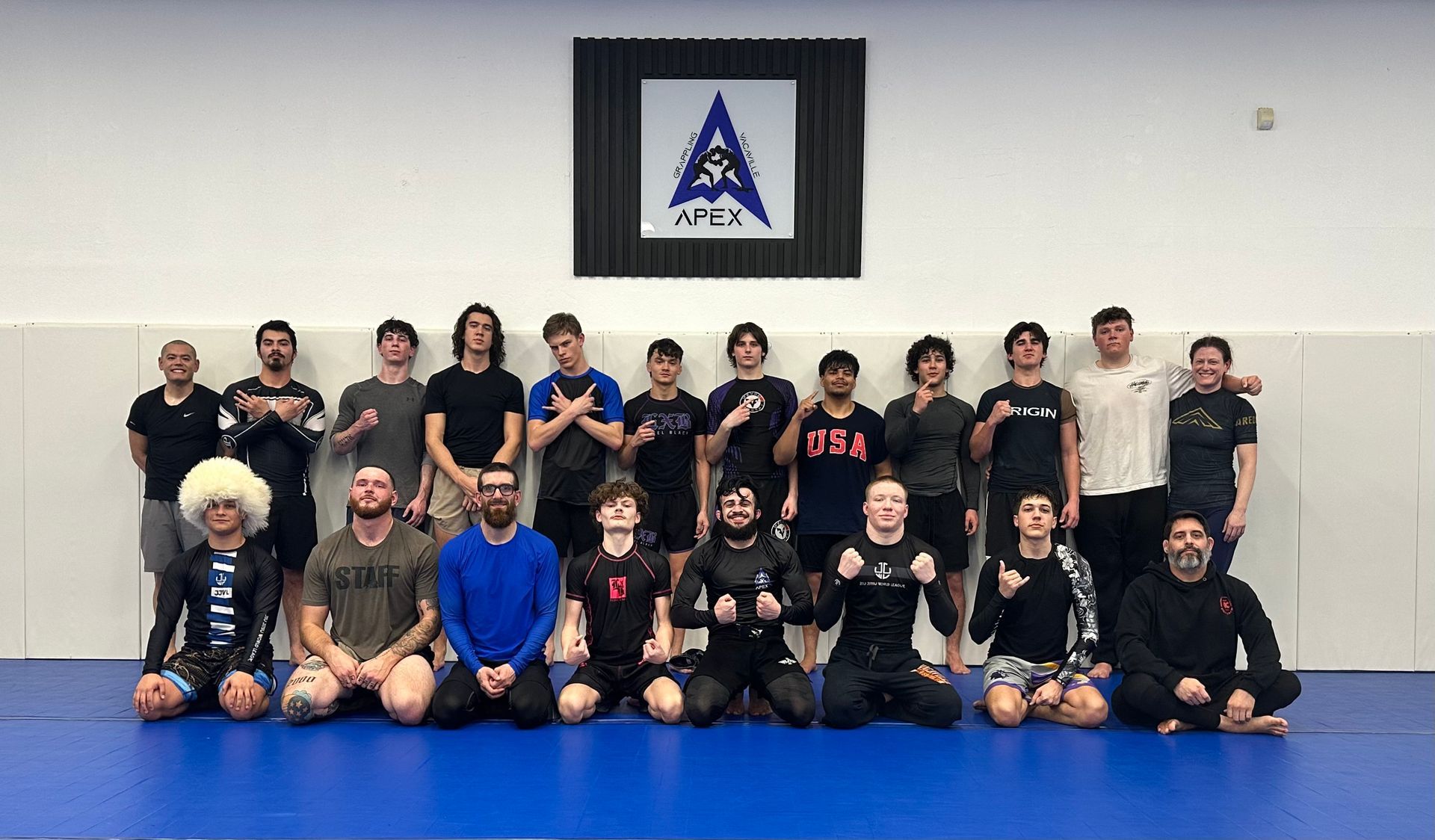
Train alongside dedicated coaches and teammates by joining a grappling class at Vacaville Grappling Academy.