Grappling is one of the few workouts that trains your body and your nervous system at the same time.
If you have been looking for a way to feel calmer, more confident, and more like yourself again, grappling can be an unexpectedly effective path. We see it every week: adults come in for fitness or self-defense, then realize the bigger change is happening upstairs, in the mind. The best part is that it does not require you to be naturally athletic or aggressive. It requires you to show up, learn, and breathe through hard moments.
In Vacaville, adult stress has a particular flavor: long workdays, commuting rhythms, family responsibilities, and for many people, a close connection to military and first-responder life. Our mats become a place where you can put the phone down, focus on one thing, and leave with your head clearer than when you arrived. That is not just motivation talk. Modern research is increasingly pointing to real, measurable mental health benefits from consistent grappling practice, including improved emotional regulation, resilience, and sleep quality.
Why grappling feels different from typical exercise
A run can be meditative, and lifting can be empowering, but grappling asks for something extra: attention under pressure. You are solving a physical puzzle in real time. Your brain has to notice position changes, choose options, and commit, even when your heart rate is up. That blend of movement and strategy is a big reason adults report reductions in anxiety and improved mood beyond what they get from standard workouts.
We also train in a structured, controlled environment. You are not trying to hurt anyone, and nobody is trying to hurt you. You are learning how to apply technique with control, and how to tap and reset when a partner has you beat. That repeated cycle of effort, problem-solving, and safe boundaries teaches your nervous system a powerful lesson: intensity is survivable, and you can stay calm inside it.
The brain science behind calmer moods and sharper focus
When you train consistently, your brain adapts. Exercise in general supports neuroplasticity, but grappling adds decision-making, spatial awareness, and stress inoculation. Research discussions around martial arts training have highlighted mechanisms like increased brain-derived neurotrophic factor, or BDNF, which supports learning, memory, and overall brain health, especially as adults age.
In plain language, we are practicing learning while tired. That matters. When you come to class after a demanding day and still manage to learn a new guard pass or escape, you are building confidence that carries into the rest of your life. You start to trust your ability to think clearly when things are not comfortable.
Executive function in real time
Grappling rewards planning, patience, and the ability to pause instead of panic. Those are executive function skills: inhibition, working memory, and cognitive flexibility. In training, you might want to explode out of a bad position, but you learn to slow down, frame, breathe, and take the next best step. Over time, that pattern becomes familiar. Many adults describe fewer mental spirals and better emotional control outside the gym, because they are used to finding the next move.
Anxiety and depression: why the benefits go beyond endorphins
Yes, you get endorphins. But the mental health value of grappling often comes from something more practical: you practice dealing with stress on purpose. Anxiety tends to shrink when your body learns, through experience, that stress does not equal danger. On the mat, your body might interpret pressure or fatigue as alarming at first. Then you realize you can manage it with posture, breathing, and technique.
We also keep you engaged. Rumination has less room to grow when you are focused on grips, balance, and timing. There is a real sense of relief in being fully present for an hour. It is not mystical. It is just hard to worry about emails while you are defending a choke with good fundamentals.
Emotional regulation: learning to stay composed when it counts
One underrated skill in grappling is the reset. You try something, it fails, you breathe, and you try again. That cycle looks simple, but it is emotional training. Adults often carry frustration, perfectionism, and self-criticism into fitness spaces. On the mat, we help you reframe progress as a process of small, repeatable wins.
That is why many practitioners report improvements in self-control and empathy over time. You cannot train well if you treat partners like opponents you need to dominate. You get better when you communicate, match intensity, and stay respectful. That cooperative intensity is a big reason grappling communities often feel socially supportive, which is a key protective factor for mental health.
Stress relief you can feel in your body
Stress is not just a thought. It is shoulders up, jaw tight, shallow breathing. Grappling gives you a physical outlet, but with structure. We guide you through warmups that raise your heart rate, drills that build competence, and live rounds that let you test yourself. By the end, most adults feel a quiet kind of fatigue, the good kind, where the body finally lets go.
This physical exhaustion also connects to sleep. Many grapplers report falling asleep faster and sleeping more deeply, partly because the body is tired, and partly because the mind has had a clean break from daily noise. Better sleep alone can improve mood, patience, and focus in a noticeable way.
Confidence and self-efficacy: the mental health benefit nobody expects
A lot of adults come in thinking confidence is a personality trait. In our experience, confidence is often a skill built through evidence. You collect proof that you can learn, adapt, and handle pressure. Grappling provides that proof quickly, because the feedback is immediate and honest.
You also learn boundaries. Tapping is not failure. It is communication. It is choosing safety and learning. That mindset can be surprisingly healing for adults who are used to pushing through everything. On the mat, we train you to listen to your body and speak up, which can translate into healthier boundaries at work and at home.
Social connection in a world that feels isolated
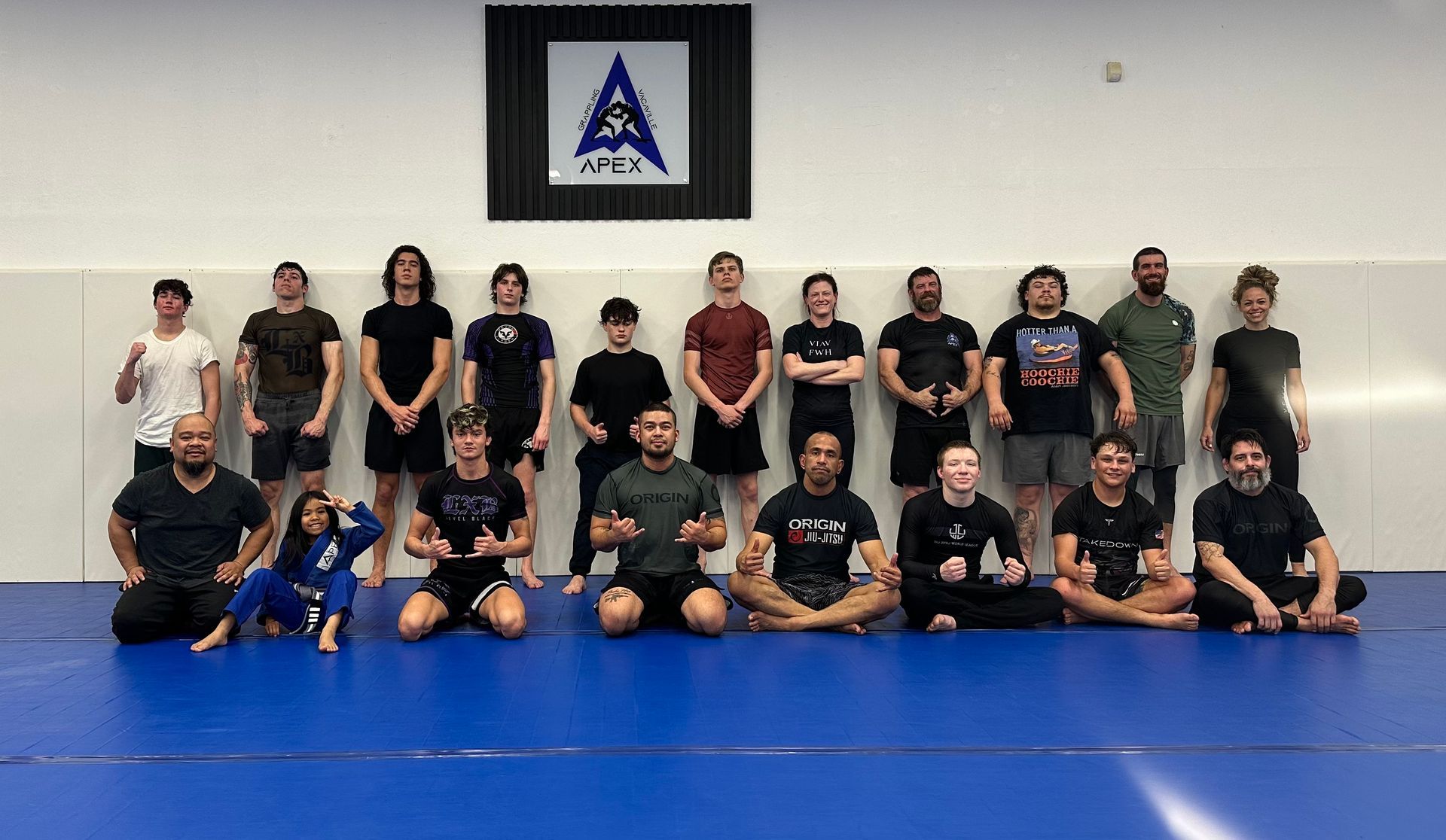
Vacaville is friendly, but adult life can still be isolating. People work, commute, handle family logistics, and sometimes realize weeks have passed without meaningful connection. Grappling classes create connection without pressure to be socially perfect. You show up, you train, you learn names over time, and you build trust through consistent effort.
That matters for mental health. Social support is strongly linked to resilience, especially during stressful seasons. Training partners notice when you are improving, and you notice when others are improving. That shared progress is simple, but it is real.
Grappling and PTSD: a controlled environment for nervous system recovery
National conversations around Brazilian Jiu-Jitsu and related grappling arts increasingly include veterans and first responders. Many report reductions in PTSD symptoms, lower reliance on unhealthy coping habits, and improved mindfulness. One reason is that training provides controlled exposure to stress cues: pressure, adrenaline, the feeling of being trapped, all within a safe framework and with clear rules.
Near Travis Air Force Base, many Vacaville adults understand that stress can be more than just being busy. If you are carrying hypervigilance, sleep disruption, or a constant sense of readiness, grappling can offer a structured way to retrain your stress response. We emphasize safety, consent, and progressive intensity, so you can build tolerance and trust at your own pace.
What to expect as an adult beginner
You do not need to get in shape before you start. We build conditioning and technique together. The first few classes are mostly about learning how to move safely, how to tap, and how to stay relaxed enough to actually learn.
You can expect a learning curve, and that is normal. Grappling is technical. But you will also feel progress early, because even one or two small details, like how to frame with your forearms or keep your elbows tight, can change everything.
A simple timeline for mental health gains
Most adults notice subtle changes quickly: better mood after class, less restlessness at night, a calmer baseline. For deeper changes like resilience and emotional regulation, consistency matters. Research follow-ups often point to meaningful improvements around the two-month mark with steady attendance, commonly 2 to 3 sessions per week.
Here is a practical approach we recommend for most beginners:
1. Train twice per week for the first month to build habit and reduce soreness.
2. Add a third weekly session if your schedule and recovery allow it.
3. Track your sleep and mood for eight weeks so you can see the pattern clearly.
4. Focus on fundamentals, not winning, to keep stress low and learning high.
5. Ask questions after class so confusion does not turn into frustration.
Safety, control, and why you do not need an aggressive personality
A common worry is that grappling looks intense, so it must attract intense people. Our culture is the opposite: we reward control. We coach you to apply technique gradually, protect training partners, and stop immediately when someone taps. That environment tends to reduce aggression, not increase it, because you are practicing restraint as a core skill.
We also scale training. If you have old injuries, anxiety, or a low fitness baseline, we adjust pace and partner selection so you can build up safely. The goal is sustainable progress. Your mental health improves when training feels like something you can keep doing, not something you survive.
How family training fits in without losing the adult focus
Even though this topic is adult mental health, family life matters. Many adults feel better when their household routines support wellness. If you are looking for a shared activity, youth options can be a practical extension of what you are building as an adult.
We often talk with parents who want their kids to gain confidence, discipline, and healthy outlets, and we offer youth grappling classes Vacaville families can fit into busy weeks. When kids train, parents see the language of calm problem-solving show up at home. When parents train too, it becomes a shared culture, not just another appointment.
Why grappling in Vacaville can be a realistic wellness habit
Consistency is where the mental health benefits really compound. That means your training needs to fit your life. Vacaville is a city where people balance work, family, and commutes, so we keep our approach practical: clear instruction, purposeful rounds, and a welcoming room where you can show up as you are.
Grappling also offers something that many adult wellness plans miss: a skill. You are not only burning calories. You are learning a system. Skill-building is psychologically protective, because it creates a sense of progress and control, even when other parts of life feel messy.
Take the Next Step
Building a healthier mind often looks less like a big breakthrough and more like a steady practice you can rely on. That is exactly what we aim to provide, and it is why we built our adult programs the way we did at Vacaville Grappling Academy. You come in, you learn something real, you train with supportive partners, and you leave a little more grounded than you arrived.
If you are interested in grappling for anxiety, stress, confidence, or simply a better relationship with pressure, we would love to help you start in a way that feels safe and doable. You can also explore the program options on the website and check the class schedule to find times that fit your week.
Improve strength, conditioning, and control through grappling training at Vacaville Grappling Academy.